


Blocking an enzyme’s manufacturing restored mind progress and wholesome behaviors in mice engineered to develop Angelman syndrome, pointing to a potential remedy goal.
Youngsters with Angelman syndrome start to point out difficulties with considering and motion at round 6 months of age. The uncommon situation happens in roughly one in 20,000 births and is attributable to the absence of a gene usually inherited from the mom. Researchers know which gene is lacking, however they’ve struggled to elucidate why its absence causes these issues, making remedies elusive.
Analysis in mice now factors to a sequence of occasions that connects the lacking gene to a stress response that interferes with mind progress. A workforce led by Jason Yi, PhD, an assistant professor of neuroscience at Washington College College of Drugs in St. Louis, traced that response to a buildup of a usually innocent enzyme. The research was printed in Nature.
One lacking gene, many extra proteins
The lacking gene, UBE3A, produces an enzyme referred to as ubiquitin ligase, which helps maintain cells orderly by marking unneeded proteins for disposal. It’s energetic all through the mind and participates in 60 totally different mobile processes. Figuring out which of these processes contribute to Angelman syndrome required narrowing that broad discipline of prospects.
Yi and his colleagues developed modified cells within the laboratory with UBE3A deactivated, then regarded for proteins that accrued with out it. They recognized 23 candidate proteins whose ranges elevated. One stood out for its robust connection to ubiquitin ligase’s regular housekeeping perform: asparagine synthetase, an enzyme that helps cells produce important proteins.
A false alarm slows mind progress
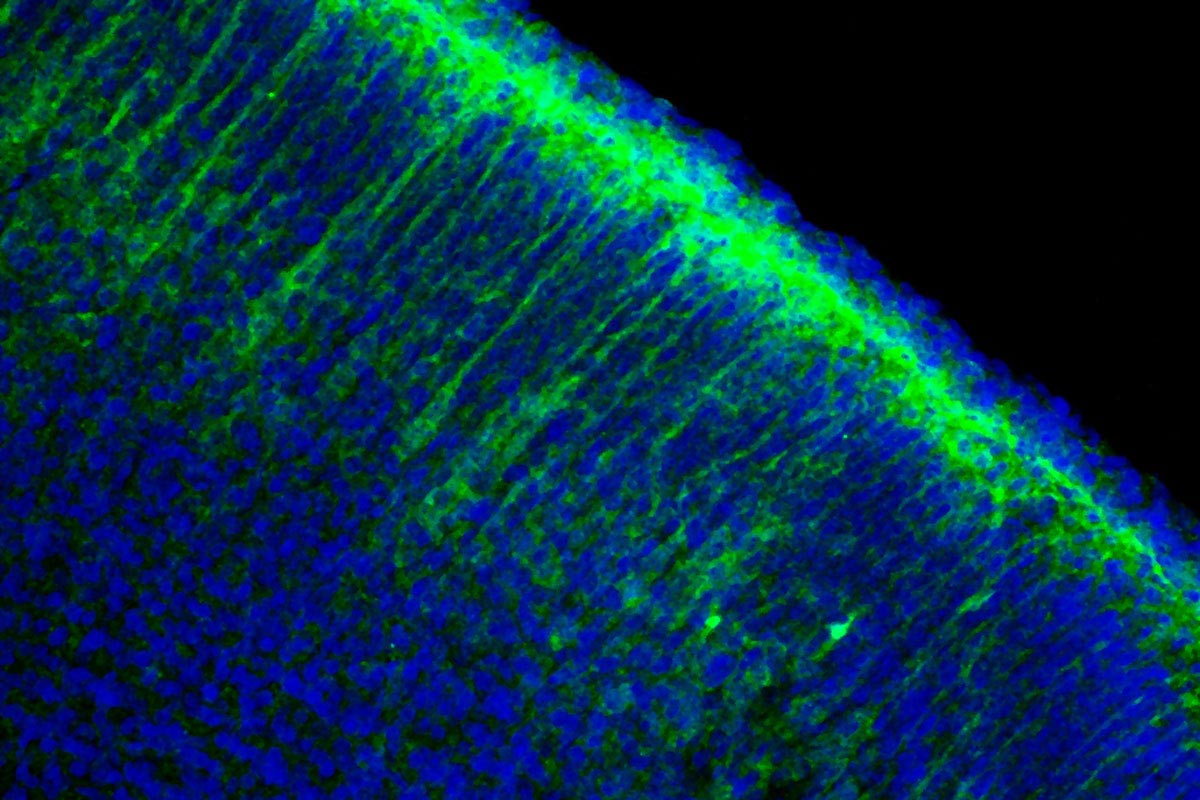
In mice genetically modified to develop Angelman syndrome, elevated ranges of asparagine synthetase activated the mind’s stress response. But the enzyme doesn’t work together with the same old triggers for that response, and its overabundance doesn’t in any other case injury the cell. The results as a substitute come up not directly, because the stress response sharply reduces protein manufacturing and progress.
“The neurons are tricked into considering that they’re in stress after they’re not — that’s unhealthy as a result of they are going to then not develop usually,” Yi stated, noting that almost all youngsters with Angelman syndrome have smaller brains than their friends of the identical age. “It’s a response from the mind attempting to preserve assets to guard itself. It does counsel that there’s a dysregulation within the mind we’d be capable to right.”
An enzyme affords a potential remedy goal
Blocking the manufacturing of asparagine synthetase restored regular mind progress and wholesome behaviors within the mice. The workforce had corrected a later step within the organic sequence set off by the lacking gene, permitting wholesome improvement to renew.
The research is the primary to hyperlink a rise in asparagine synthetase to a neurological situation. It provides to proof that an imbalance in proteins can contribute to neurodevelopmental issues by triggering stress responses, even when the proteins themselves usually are not straight damaging cells.
Yi stated medicines may probably goal the stress response triggered by asparagine synthetase, however a lot stays to be discovered earlier than work on a potential remedy can start. His workforce is investigating exactly why the enzyme prompts that response, the place within the mind the response is most energetic, and when throughout improvement medical interventions can be only.
“We nonetheless don’t know a complete lot in regards to the illness,” stated Yi. “We haven’t been capable of establish all the issues that the lacking gene is doing and rescue the issues that it’s not doing in Angelman’s syndrome. However I feel our information are essentially the most full to date to start answering these questions.”
Reference: “Persistent neuronal stress signalling underlies Angelman syndrome phenotypes” by Kwang-Soo Kim, Cory Gardner, Alissa Cullen, Jalin A. Stelzer, Kevin Cho, Ashish Sharma, Mati T. Nemera, Travis Legislation, Huma Naz, Guoyan Zhao, Harrison W. Gabel, Gary J. Patti, Erik S. Musiek, Tae-Hyuk Ahn and Jason J. Yi, 21 October 2026, Nature.
DOI: 10.1038/s41586-026-11165-4