


Scientists have developed an experimental technique that exploits a chemical byproduct of most cancers cells to supply anticancer medication straight inside them.
Scientists in Japan have developed an experimental technique that makes use of a chemical produced by most cancers cells to fabricate anticancer medication straight inside them. The method depends on carbon monoxide, a poisonous fuel that sure tumors produce in unusually excessive quantities, to activate a chemical response designed to destroy most cancers cells whereas limiting harm to wholesome tissue.
In a proof-of-concept examine printed in Nature Communications, researchers on the RIKEN Pioneering Analysis Institute (PRI) demonstrated that their system may generate drug compounds selectively in cultured most cancers cells. The findings counsel a doable different to traditional chemotherapy, though the method has not but been examined in animals or people.
Turning a Most cancers Byproduct Right into a Remedy
Carbon monoxide is finest referred to as a toxic fuel launched throughout incomplete combustion, together with in car exhaust. Nonetheless, the human physique additionally produces small quantities of it naturally. Analysis has proven that many varieties of most cancers cells generate elevated ranges, making a chemical distinction that would doubtlessly be exploited for focused therapy.
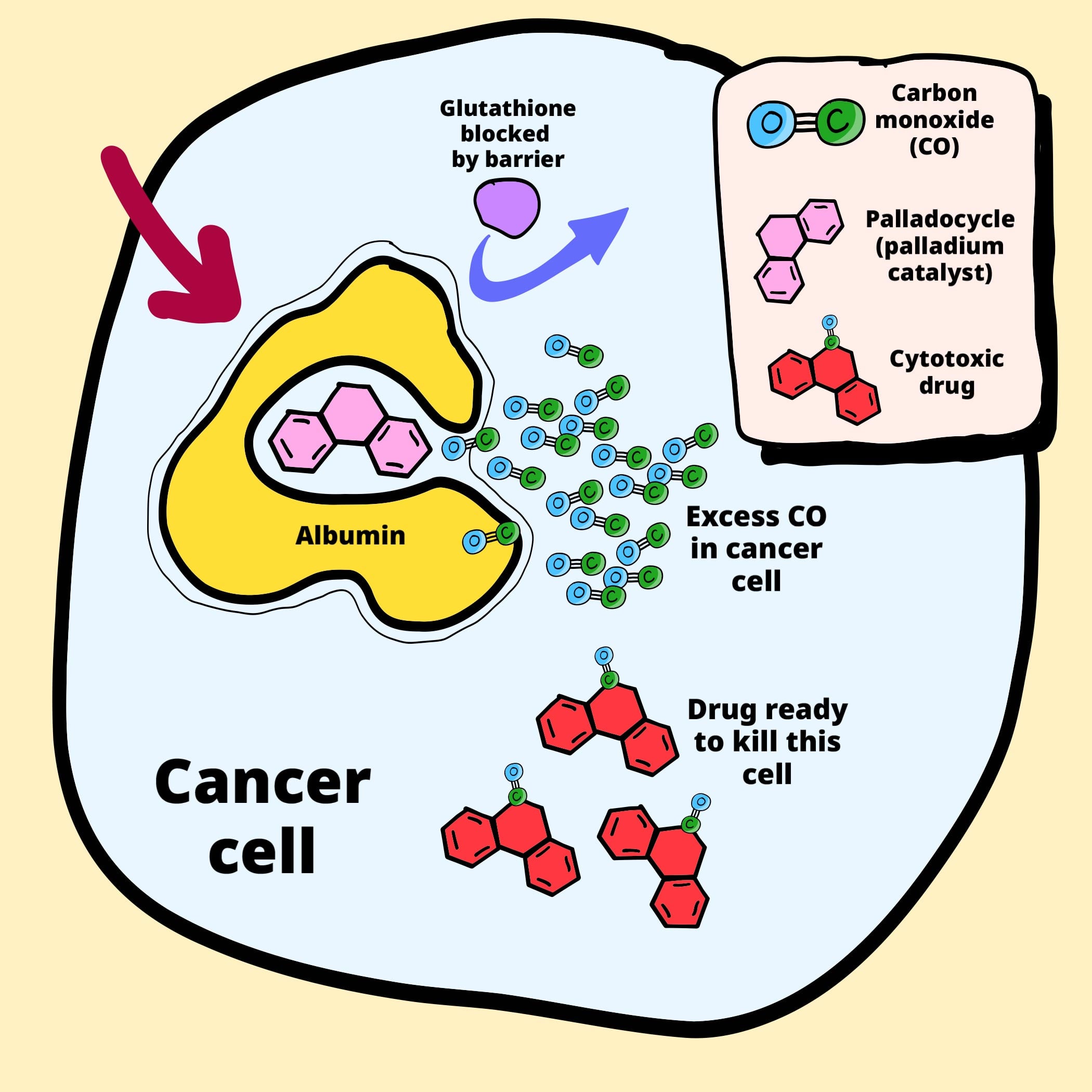
A staff led by Katsunori Tanaka investigated whether or not this extra carbon monoxide may function a uncooked materials for producing anticancer compounds inside tumors. Their technique makes use of palladacycles, organometallic compounds containing palladium, to transform carbon monoxide right into a molecule referred to as phenanthridinone. Sure phenanthridinone derivatives are poisonous to cells and have been utilized in anticancer medication.
Defending a Delicate Chemical Response
The researchers confronted a major impediment: palladium catalysts are quickly deactivated by substances naturally current inside cells, together with glutathione. With out safety, the catalyst would lose its potential to hold out the drug-producing response.
To unravel this downside, the staff enclosed a palladacycle inside albumin, an plentiful protein present in blood. Albumin acts as a protecting service, shielding the palladium catalyst from molecules that might in any other case disable it. The ensuing albumin complicated can flow into via the bloodstream and stay chemically lively after coming into cells.
After screening a number of palladacycles to establish the best candidate, the researchers examined the protected complicated in opposition to human liver, cervical, breast, and lung most cancers cell strains, together with a noncancerous cell line.
Most cancers Cells Produce the Drug Compounds
Following 48 hours of incubation, the researchers detected the supposed phenanthridinone product in all 4 most cancers cell strains however not within the noncancerous cells. The outcomes indicated that the protected catalyst remained practical and that the response trusted chemical circumstances related to the most cancers cells.
The staff then refined the system to permit the newly synthesized compound to separate from its service and transfer freely inside the cell. Additional modifications enabled the manufacturing of a extremely poisonous phenanthridinone spinoff utilized in anticancer medication. When examined in liver most cancers cells, the modified system generated the poisonous compound internally, inflicting dangerous results in these cells.
One other concern was whether or not carbon monoxide already current in blood would possibly activate drug manufacturing earlier than the complicated reached a tumor. Blood exams confirmed no detectable formation of the poisonous compound. The researchers prompt that carbon monoxide sure to hemoglobin, the oxygen-carrying protein in pink blood cells, was unavailable to take part within the response.
The Subsequent Step Towards Focused Most cancers Remedy
Fairly than administering a completed anticancer drug, Tanaka’s method goals to ship comparatively innocent chemical parts that turn into poisonous solely after encountering appropriate circumstances inside diseased cells.
“This work represents an essential advance in therapeutic in vivo artificial chemistry,” says Tanaka. “In our therapeutic technique, molecules naturally current or generated inside the physique—together with disease-associated metabolites—are used as endogenous chemical feedstocks to synthesize therapeutic molecules straight on the web site of illness.”
The researchers’ subsequent step is to check the tactic in animal fashions, the place they’ll examine whether or not the catalyst reaches tumors, produces enough quantities of the drug, and avoids damaging wholesome tissues.
Reference: “Harnessing endogenous carbon monoxide for cancer-selective drug synthesis” by Masayuki Kawai, Tsung-Che Chang, Ambara R. Pradipta and Katsunori Tanaka, 17 September 2026, Nature Communications.
DOI: 10.1038/s41467-026-77616-8