


How the floor beneath a protein can affect the buildings it varieties
What determines whether or not nanoscale constructing blocks assemble into an ordered construction or stay disordered?
In a examine printed in Nature Communications, Sakshi Yadav Schmid and colleagues investigated this query utilizing designed protein nanorods at liquid–strong interfaces. Combining high-speed atomic pressure microscopy (HS-AFM), machine-learning evaluation and computational modelling, they explored how the floor beneath the proteins influences their motion and group.
The researchers noticed a hanging distinction: the identical protein nanorods shaped totally different preparations on two varieties of mica, regardless that each surfaces have the identical potassium-ion sublattice to which the proteins have been designed to bind. Their findings reveal why understanding nanoscale meeting requires wanting past the interactions intentionally constructed into the protein design.
Following protein meeting in actual time
Self-assembly happens when particular person constructing blocks manage into bigger buildings by interactions with each other and their environment. To grasp how these buildings kind, it helps to watch the method because it unfolds—not simply look at the ultimate association.
Excessive-speed AFM allowed the researchers to watch the protein nanorods in liquid because the meeting course of unfolded. Utilizing NanoWorld ARROW-UHFAuD and USC-F1.2-k0.15 cantilevers of their high-speed AFM experiments, they might comply with how the nanorods moved and the way their preparations modified over time, fairly than relying solely on photographs of the ultimate buildings.
The experiments in contrast two substrates: muscovite mica (m-mica) and fluorophlogopite mica (f-mica). Beneath the high-salt circumstances investigated, the nanorods behaved very otherwise on the 2 surfaces.
On muscovite mica, the nanorods have been extremely cellular. Small teams of aligned rods appeared, grew and rearranged till a extra steady, layered construction emerged. This association is called smectic order: the elongated constructing blocks level predominantly in the identical course and are organized into layers.
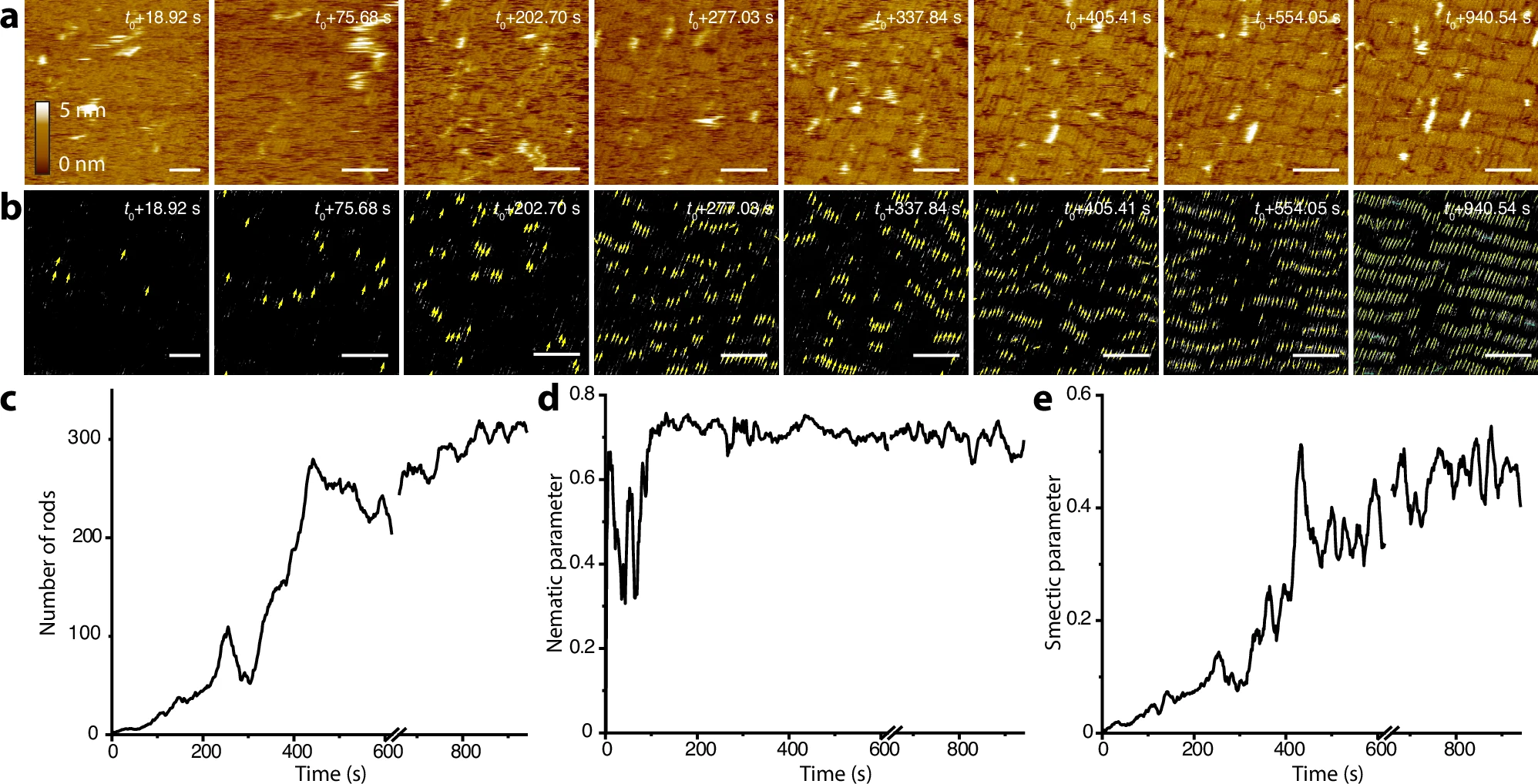
Supply: Yadav Schmid et al., Nature Communications 17, 2446 (2026), https://doi.org/10.1038/s41467-026-69170-0. © Battelle Memorial Institute and The Authors 2026. Licensed beneath CC BY 4.0. Reproduced with out modification.
On fluorophlogopite mica, the rods confirmed translational and rotational motion however have been much less cellular total. Their orientations adopted three instructions related to the substrate’s potassium-ion sublattice. As extra rods accrued, they shaped a high-density disordered meeting, fairly than the layered construction seen on muscovite mica.
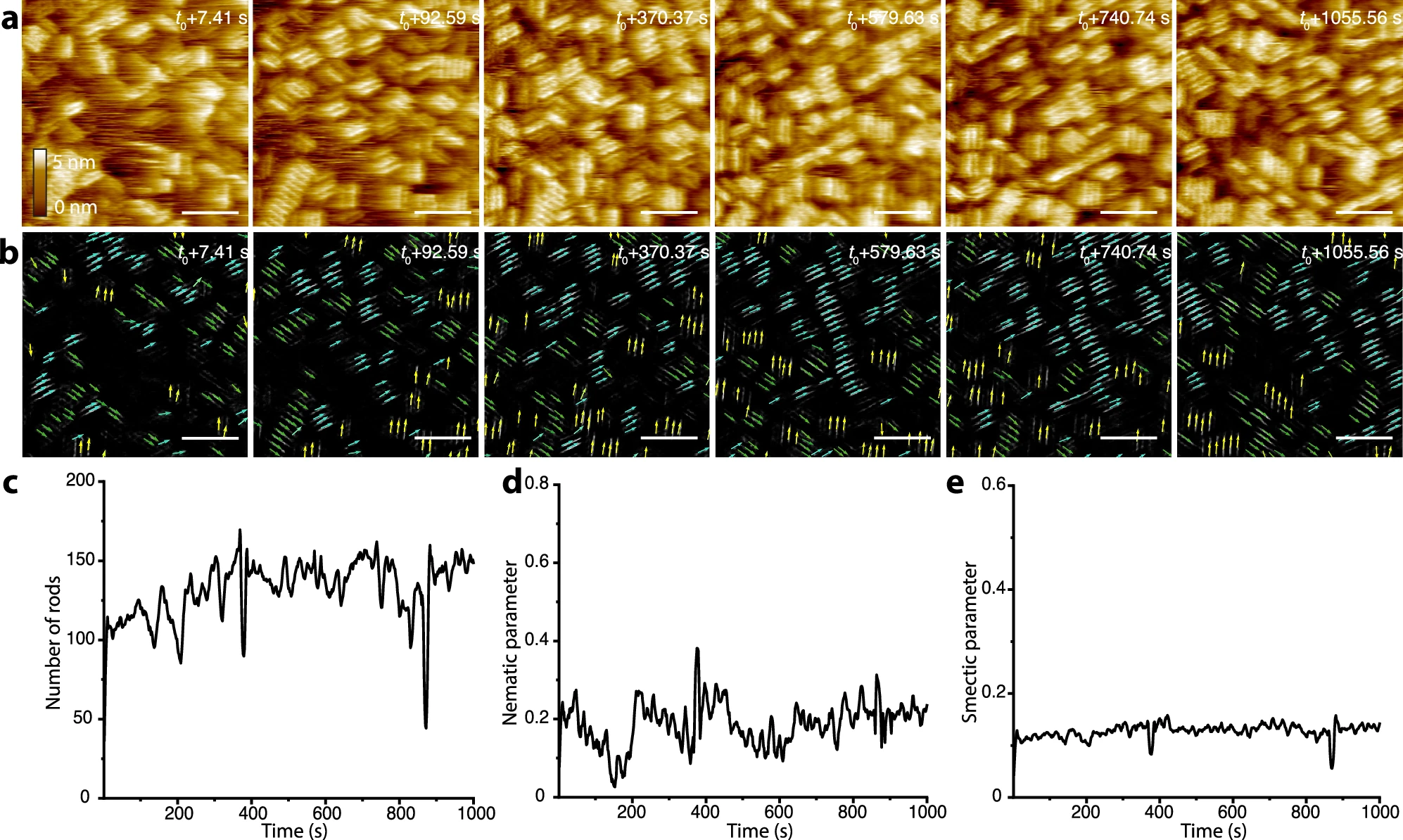
Supply: Yadav Schmid et al., Nature Communications 17, 2446 (2026), https://doi.org/10.1038/s41467-026-69170-0. © Battelle Memorial Institute and The Authors 2026. Licensed beneath CC BY 4.0. Reproduced with out modification.
The distinction was notably intriguing as a result of the potassium-ion patterns that information protein binding are equivalent on the 2 substrates. One thing past that shared sample was influencing the result.
Measuring how order develops
Watching nanorods transfer offers a view of self-assembly in motion. However how can researchers measure the transition from particular person actions to collective group?
The workforce used machine-learning strategies to determine nanorods within the high-speed AFM photographs and decide their positions and orientations. From these measurements, they might monitor floor protection and calculate how the diploma of order modified over time.
Two portions have been particularly helpful. Nematic order describes how strongly elongated objects align in a standard course. Smectic order moreover captures their group into layers.
On muscovite mica, the nanorods aligned comparatively rapidly, whereas their layered group developed extra steadily as floor protection elevated. On fluorophlogopite mica, the rods accrued with out growing comparable long-range alignment or smectic order.
This quantitative evaluation confirmed not solely that the ultimate buildings differed, but in addition how the 2 meeting processes adopted totally different paths.
Why the floor issues
What might clarify such totally different habits on substrates with equivalent potassium-ion sublattices?
An essential clue lies within the water subsequent to the strong floor. The atomic buildings of muscovite and fluorophlogopite mica differ in ways in which affect the association of close by water molecules. These interfacial hydration buildings can, in flip, have an effect on the interactions skilled by the protein nanorods.
To research this rationalization, the researchers used Monte Carlo simulations that thought of the mobility of rod-shaped constructing blocks and the affect of most well-liked orientations imposed by the substrate. When the mannequin launched a directional desire representing the damaged symmetry related to muscovite mica, smectic ordering might emerge. With out that desire, the mannequin reproduced habits per disordered meeting.
The excellence between the strategies is essential: high-speed AFM revealed how the nanorods moved and assembled, machine-learning evaluation quantified the growing order, and the simulations helped clarify how surface-related results might produce the noticed variations.
The findings spotlight an element that’s simple to miss when designing protein assemblies: the encircling liquid and the construction of the underlying floor can affect the result, even when the supposed protein–floor binding sample is identical.
By revealing these results as meeting occurs, high-speed AFM offers an experimental window into processes which may be obscure from completed buildings alone. Mixed with quantitative evaluation and modelling, such observations will help researchers develop a extra full understanding of how designed proteins manage at interfaces.
Full quotation
Yadav Schmid, S.; Helfrecht, B.; Stegmann, A.; Legg, B. A.; Pyles, H.; Chen, J.; Edison, J. R.; Ziatdinov, M.; Preisler, Z.; Greenback, O.; Whitelam, S.; Kalinin, S.; Baker, D.; Mundy, C. J.; Zhang, S.; De Yoreo, J. J.
Impression of solvent forces and damaged symmetry on the meeting of designed proteins at a liquid-solid interface.
Nature Communications 2026, 17, 2446.
https://doi.org/10.1038/s41467-026-69170-0
Inventive Commons Attribution 4.0 Worldwide (CC BY 4.0)