


What occurs to the crystalline constructions inside a semicrystalline polymer when the fabric is stretched? A research by Xabier Larrañaga and colleagues, printed in Macromolecules, reveals two contrasting deformation pathways in poly(L-lactic acid) (PLLA): fragmentation, through which crystalline order is domestically retained, and mechanical disintegration, through which the construction turns into considerably much less ordered. Atomic power microscopy (AFM), mixed with Raman spectroscopy and polarized-light microscopy, helps clarify these totally different responses.
Bodily ageing and the deformation of PLLA
PLLA is a polymer whose mechanical response relies upon strongly on its molecular construction and processing historical past. In semicrystalline PLLA, ordered constructions known as spherulites coexist with much less ordered, amorphous areas. How these elements work together beneath mechanical stress influences whether or not the fabric fractures or undergoes plastic deformation.
An necessary issue is bodily ageing. Because the amorphous polymer relaxes towards a lower-energy state over time, molecular mobility can turn out to be extra restricted, making plastic deformation tougher beneath the investigated situations.
Larrañaga and colleagues examined two associated elements of PLLA deformation: the affect of managed bodily ageing on the brittle-to-ductile transition of glassy PLLA, and the deformation behaviour of spherulites in semicrystalline PLLA. These have been distinct experimental investigations.
Within the glassy PLLA experiments, the least-aged samples exhibited a brittle-to-ductile transition at −30 °C, whereas extra strongly aged samples required larger temperatures to deform in a ductile method beneath the reported testing situations.
These findings present context for understanding the significance of the amorphous chain community in polymer deformation, whereas the separate semicrystalline experiments reveal how spherulites reply when the encircling materials undergoes plastic deformation.
Two deformation pathways: fragmentation and disintegration
When semicrystalline PLLA movies have been stretched, the researchers noticed two distinct responses of the spherulites.
In fragmentation, a spherulite separates into smaller areas, whereas attribute crystalline construction stays domestically preserved throughout the fragments.
In mechanical disintegration, the response is totally different. The previous spherulite stays recognizable, however its crystalline construction undergoes substantial disordering throughout deformation.
The authors interpret these contrasting pathways by way of the mechanical interplay between crystalline areas and the encircling amorphous chain community. They suggest that connectivity via bridging polymer chains performs a job in whether or not crystalline domains separate into fragments or bear extra in depth structural rearrangement.
To look at these modifications at a neighborhood scale, the researchers mixed AFM floor imaging with mechanical measurements.
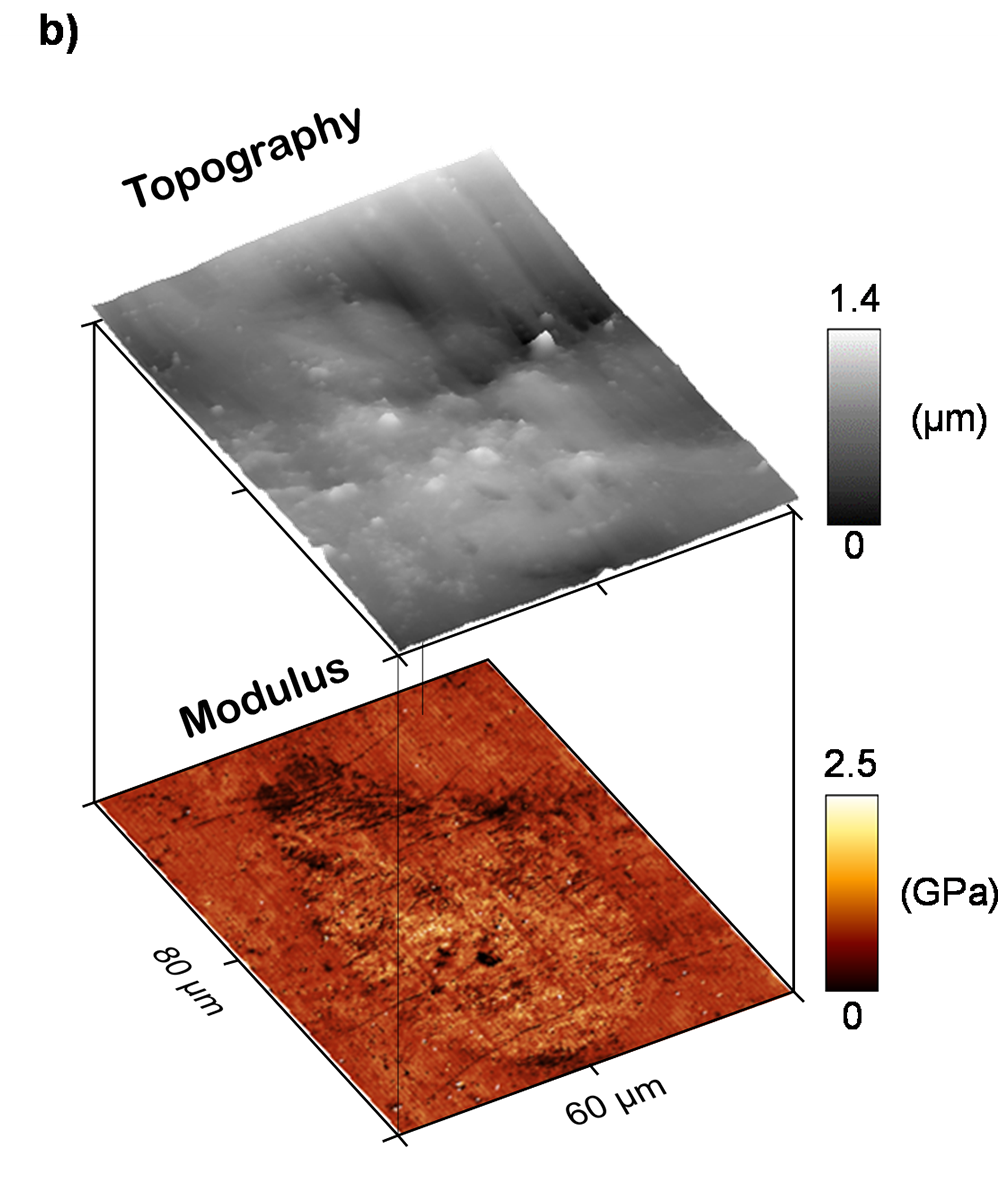
Tapping-mode AFM supplied details about floor topography, whereas AFM power–displacement measurements and nanoindentation-derived Younger’s modulus maps revealed variations in native stiffness.
Younger’s modulus describes a cloth’s resistance to elastic deformation. Mapping this property throughout a deformed spherulite helps distinguish mechanically totally different areas that might not be obvious from floor morphology alone.
In fragmented spherulites, the AFM measurements revealed alternating areas of upper and decrease stiffness. Domestically stiff domains reached roughly 2.4 GPa. Along with the complementary Raman proof, these measurements assist the interpretation that crystalline areas remained throughout the fragments.
The mechanically disintegrated spherulites confirmed a unique response.
Though the previous spherulite may nonetheless be recognized within the AFM topography, its measured stiffness was a lot nearer to that of the encircling amorphous materials. The reported AFM-derived Younger’s modulus was 1.01 ± 0.35 GPa for the disintegrated spherulite, in contrast with 0.92 ± 0.14 GPa for adjoining amorphous areas.
This lowered mechanical distinction is according to substantial structural reorganization. It doesn’t imply that the spherulite had bodily disappeared or that the 2 areas have been mechanically similar.
AFM probes used within the research
For AFM imaging and power–displacement measurements, the authors used noncoated silicon NanoWorld Pointprobe® NCH AFM probes.
The research mixed tapping-mode topography with native power measurements to look at the connection between floor morphology and nanomechanical response in deformed PLLA.
Raman spectroscopy supplies complementary structural proof
Whereas AFM revealed modifications in morphology and native stiffness, these measurements alone couldn’t set up whether or not crystalline order had been retained or misplaced.
The researchers due to this fact used polarized Raman spectroscopy to research modifications in molecular construction.
For fragmented spherulites, Raman spectra retained attribute signatures of crystalline PLLA throughout the separated areas. This supported the interpretation that fragmentation had occurred with out full lack of native crystalline group.
In mechanically disintegrated spherulites, a number of attribute crystalline Raman options disappeared or grew to become considerably weaker. The spectra as a substitute confirmed options extra according to a deformed, much less ordered molecular construction. This means substantial disordering slightly than essentially proving the entire disappearance of all crystalline materials.
Collectively, the AFM and Raman outcomes distinguish mechanical fragmentation from the extra in depth structural disordering related to spherulite disintegration. Polarized-light microscopy supplied extra context for the deformation morphology.
Understanding ductility in semicrystalline polymers
The research highlights why the mechanical behaviour of PLLA can’t be understood from crystallinity alone.
The experiments on glassy PLLA show the affect of bodily ageing on the brittle-to-ductile transition beneath the investigated situations. The separate semicrystalline experiments present how interactions between crystalline areas and the amorphous chain community are related to contrasting deformation responses.
By combining native AFM measurements with complementary structural characterization, Larrañaga and colleagues join modifications in morphology and stiffness with their interpretation of the underlying deformation mechanisms.
The findings contribute to a extra detailed understanding of how molecular group, bodily ageing and interactions between crystalline and amorphous areas affect the mechanical response of PLLA.
Full Quotation
Xabier Larrañaga, Brian J. Rodriguez, Jose R. Sarasua and Ester Zuza
Towards the Segmental Rest of the Chain Community: Activating the Ductile Mechanism of Each Glassy and Semicrystalline PLLA
Macromolecules 2026
https://doi.org/10.1021/acs.macromol.6c00777
Artistic Commons Attribution 4.0 Worldwide (CC BY 4.0)
https://creativecommons.org/licenses/by/4.0/