


The instruments scientists use to review cells could also be altering the very proteins they observe, elevating questions on many years of analysis into how cells preserve their construction.
For many years, textbooks and a whole lot of scientific papers have described coronin proteins as vital organizers of the interior framework that offers cells their form and helps them transfer. Now, researchers on the College of Basel in Switzerland are revisiting that longstanding clarification, exhibiting how scientific progress can typically start by questioning what we thought we already knew.
Coronins are present in organisms starting from single-celled amoebae to people. They’re concerned in important processes similar to immunity, growth, and cell survival. Scientists have historically seen them as proteins that work together with actin, a significant part of the cytoskeleton. This community of tiny filaments helps a cell’s construction, permits it to maneuver, and helps manage its contents.
Coronins could play a unique function in cells
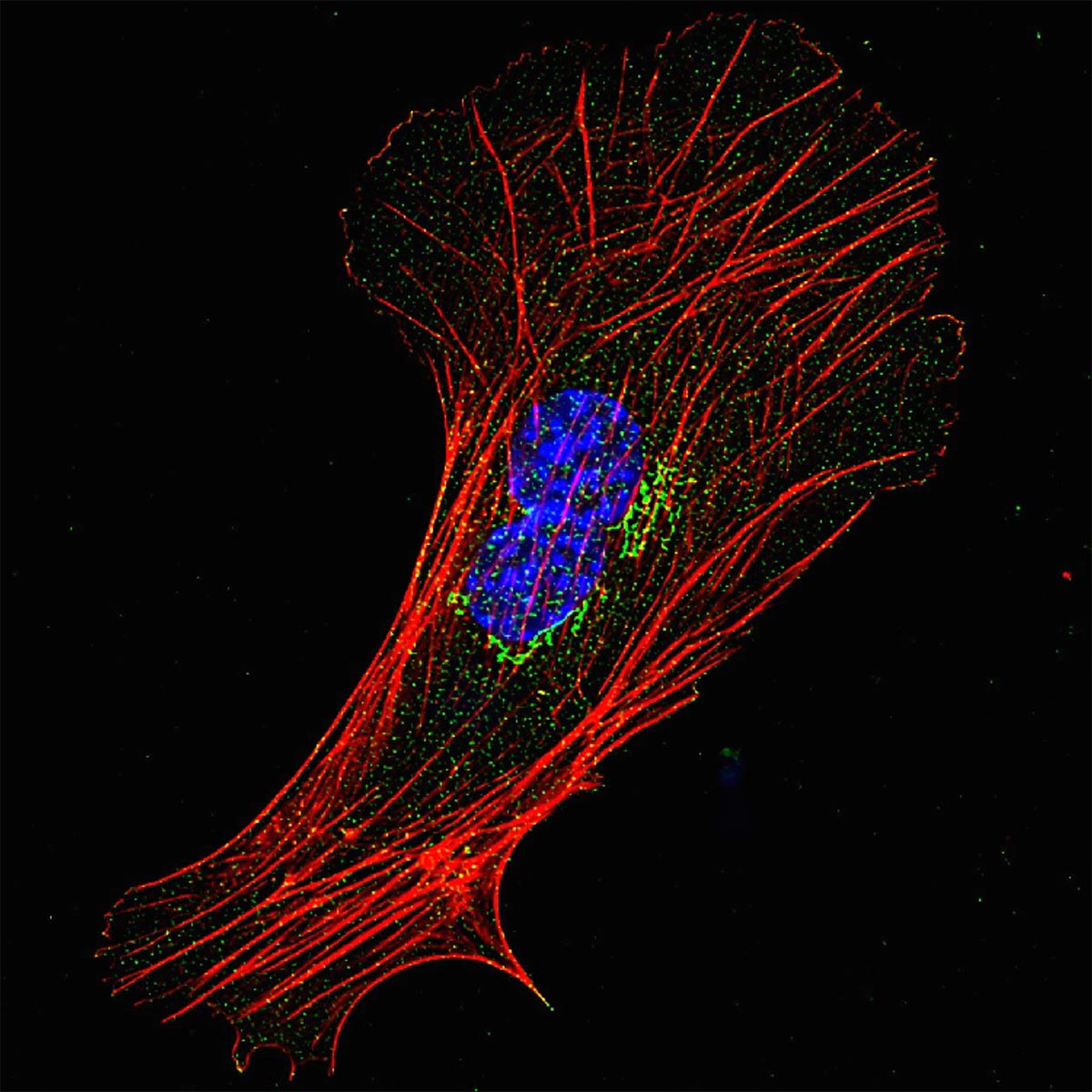
A brand new examine revealed in PLOS Biology, led by Professor Jean Pieters on the College of Basel’s Biozentrum, challenges that understanding. Utilizing a broad vary of experiments to look at coronins of their pure state, the researchers discovered that these proteins are largely pointless for the general group of the actin cytoskeleton.
“Over time, my laboratory failed to search out proof for a direct function of coronin proteins in actin binding and modulation throughout a variety of mannequin techniques,” says Pieters. “Even cells missing coronins proceed to arrange and transform their actin networks usually. In fact, absence of proof shouldn’t be proof of absence.”
Laboratory instruments could have distorted outcomes
The staff additionally recognized a attainable purpose why earlier research reached totally different conclusions. To watch proteins inside dwelling cells, scientists typically connect molecular tags that make them simpler to trace. Though these instruments are broadly used, they will typically intrude with the proteins being studied.
“These tags are extraordinarily helpful and assumed to be innocuous for protein operate,” says Roko Gvozdenica, the examine’s first creator. “Nonetheless, we discovered that the tagging of coronin proteins has the potential to trigger lack of their operate and considerably alter their localization.”
This raises the chance that some earlier proof linking coronins to actin resulted from experimental artifacts reasonably than their pure conduct. The researchers additionally discovered that many antibodies used to detect coronins lack specificity, including to broader issues in regards to the reliability of those instruments in biomedical analysis.
Coronins assist preserve wholesome immune cell numbers
The findings carry consideration to a different vital function of coronins: serving to cells talk by means of chemical indicators.
“Over time, now we have reported that coronins are concerned in cell signaling,” emphasizes Pieters. “Within the immune system, for instance, coronin involvement in these signaling processes was discovered to be important for the upkeep of regular T cell numbers, which is important for shielding the physique towards infections or most cancers.”
The researchers warning that their findings don’t fully rule out a connection between coronins and the cytoskeleton. These proteins should affect its group, both immediately or not directly by means of cell signaling.
By reexamining an concept that has formed analysis for many years, the examine opens new potentialities for understanding how coronins assist cells talk, survive, and preserve wholesome cell numbers.
Reference: “Reassessment of the roles of coronin proteins as actin effectors and in signaling” by Roko Gvozdenica Šipić, Haiyan Zhang, Andrii Kharin, Jerneja Koren, Viviana D’Otolo, Yuko Nariai, Takeshi Urano, Pawel Pelczar, Klemens Fröhlich, Alexander Schmidt, Urszula Brykczynska Kunzmann, Tohnyui Ndinyanka Fabrice, Alexey Baldin and Jean Pieters, 18 August 2026, PLOS Biology.
DOI: 10.1371/journal.pbio.3003904