


With iOS 27, Imaginative and prescient provides OCRTool, a system instrument you connect to a Basis Fashions session. Earlier than this, studying a canopy meant calling RecognizeTextRequest and selecting the title out of the string your self, or sending the picture to a cloud mannequin. OCRTool stays on the cellphone. You label the picture, the on-device mannequin calls the instrument when it wants the printed phrases, and also you by no means add the picture. On this tutorial, we’ll {photograph} a e book cowl and switch it right into a small card: the title, the creator, a blurb from the quilt, one line on why it is price studying, and a brief checklist of comparable books.
This follows the Basis Fashions sequence: Getting Began, @Generable, and Device Calling. You’ll be able to comply with alongside with out having constructed these pattern apps.
OCRTool is not a framework of its personal. It is a Imaginative and prescient instrument you move right into a LanguageModelSession. To comply with alongside, be sure you have Xcode 27 put in, with the iOS 27 SDK.
Able to get began? Let’s dive in.
The Demo App: Shelf Backbone
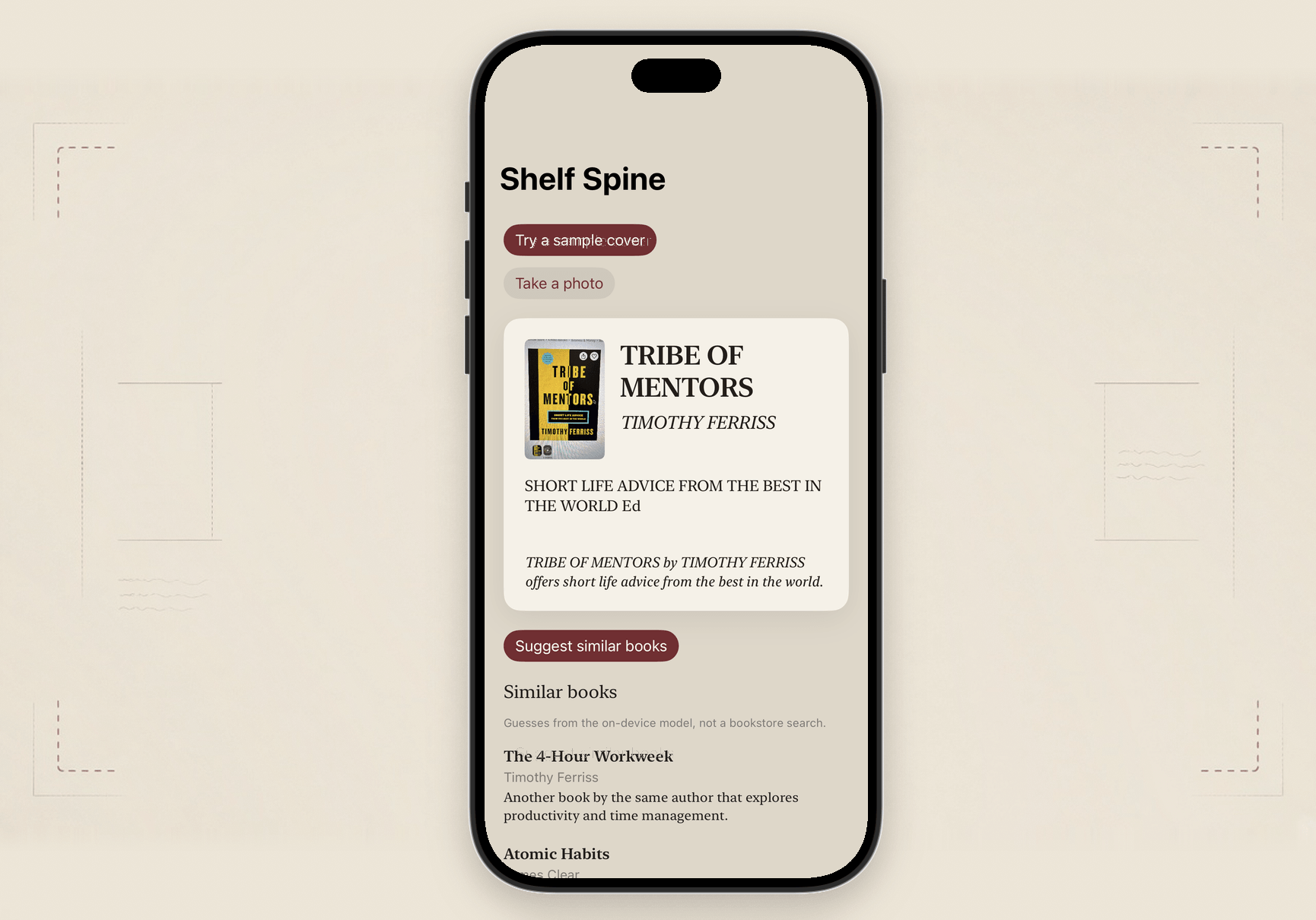
Shelf Backbone takes a canopy and robotically extracts textual content from the picture like title, subtitles, and creator. You’ll be able to obtain the demo on GitHub and check out it out.
Open it in Xcode 27 and run it on an iOS 27 simulator or on an iPhone. If you happen to take a look at it on a simulator, use the pattern cowl to check it out. For bodily iPhone, you’ll be able to take a photograph of any e book covers and let the app acknowledge the e book info. The learn makes use of SystemLanguageModel, the on-device mannequin, so the app works offline.
To learn the printed phrases on a canopy, you give a language mannequin session a Imaginative and prescient instrument known as OCRTool. It acknowledges textual content in a picture and returns a string containing all of the textual content it discovered. You do not name the instrument your self. You connect it to a LanguageModelSession, and the on-device mannequin makes use of it when the immediate wants these phrases.
You import Imaginative and prescient alongside FoundationModels and create a session with an OCRTool. Here is the essential setup from Apple’s documentation:
let ocrTool = OCRTool()
let session = LanguageModelSession(instruments: [ocrTool])
That is sufficient to get began. OCRTool() makes use of a default title and outline. If you wish to steer when the mannequin reaches for the instrument, you’ll be able to override each. Here is the way you customise them:
let customTool = OCRTool(
    title: "extractText",
    description: "Extract textual content from paperwork"
)
The title is how the instrument is uncovered to the mannequin. The description is what the mannequin makes use of to resolve when to name it.
You additionally move the picture as an Attachment and provides it a label. That label is how the mannequin identifies which picture handy to OCRTool. We’ll use that once we learn the quilt.
Another factor: OCRTool is not out there in Simulator. You may see how the pattern offers with that later.
Checking the Availability of the System Language Mannequin
The very first thing the pattern does is verify whether or not the on-device language mannequin is accessible. That is SystemLanguageModel.default.availability. If the mannequin is prepared, you present the shelf. If it is not, you present the explanation and cease. Here is the verify from the pattern:
non-public var mannequin = SystemLanguageModel.default
var physique: some View {
change mannequin.availability {
case .out there:
mainView
case .unavailable(let purpose):
Textual content(unavailableMessage(purpose))
.multilineTextAlignment(.heart)
.padding(24)
}
}mainView is the remainder of the display screen: the pattern button, the cardboard, and, later, the similar-books checklist. The unavailable department is a sentence, not a spinner. The mannequin may be lacking as a result of the gadget is not eligible, as a result of Apple Intelligence is off, or as a result of the mannequin continues to be downloading. Here is the helper that turns that purpose right into a sentence:
non-public func unavailableMessage(_ purpose: SystemLanguageModel.Availability.UnavailableReason) -> String {
    change purpose {
    case .deviceNotEligible:
        return "The gadget is just not eligible for Apple Intelligence."
    case .appleIntelligenceNotEnabled:
        return "Apple Intelligence is just not enabled on this gadget."
    case .modelNotReady:
        return "The mannequin is not prepared. It could nonetheless be downloading."
    @unknown default:
        return "The mannequin is unavailable."
    }
}
If you happen to cease right here, the app already runs. It both exhibits the shelf or it tells you why it could possibly’t.
Now that it is best to have a fundamental understanding of OCRTool, let’s have a look at how we use it to acknowledge a e book cowl.
Here is how the pattern creates the session:
non-public func makeSession() -> LanguageModelSession {
    #if targetEnvironment(simulator)
    LanguageModelSession(mannequin: mannequin, directions: directions)
    #else
    LanguageModelSession(
        mannequin: mannequin,
        instruments: [
            OCRTool(
                name: "readBookCover",
                description: "Read the printed title, author, and blurb on a book cover or spine."
            )
        ],
        directions: directions
    )
    #endif
}
OCRTool() with no arguments is sufficient when you’re proud of the default title. The pattern names it readBookCover so the immediate can ask for that instrument by title. The directions keep quick: use the printed title, creator, and blurb, and do not invent a special e book.
The #if is there as a result of OCRTool is not within the Simulator SDK. On a Mac that may run the on-device mannequin, Simulator can nonetheless fill the cardboard. It simply cannot name OCRTool.
The following step is to ask that session to learn the quilt and fill the cardboard. You try this in a single name: a brief immediate, plus the picture. The picture goes in as an Attachment, and also you give it a label, e book cowl. That label is how the mannequin is aware of which picture handy to OCRTool. Here is the decision:
card = attempt await session.reply(producing: BookCard.self) {
    "Learn this e book cowl. Use readBookCover on the picture labeled e book cowl. Fill the title, creator, and blurb from the printed phrases solely."
    Attachment(picture).label("e book cowl")
}.content material
reply(producing:) is the guided-generation name from the @Generable article. The immediate builder takes a string and the labeled attachment collectively. The pattern imports UIKit, so Attachment can take the UIImage from the digicam or from the research cowl. You’ll be able to go away the picture on the measurement the digicam gave you.
Producing a Structured E book Card
A canopy is not a paragraph you wish to break up with elements(separatedBy:). You describe the cardboard as a Swift sort, and the mannequin fills it. BookCard lives in its personal file. Here is the sort:
@Generable
struct BookCard {
    @Information(description: "The e book title printed on the quilt.")
    let title: String

    @Information(description: "The creator title printed on the quilt.")
    let creator: String

    @Information(description: "A brief blurb copied from the quilt. Depart it empty if the quilt has no blurb.")
    let blurb: String
}
@Generable builds the schema the mannequin has to comply with. Every @Information description is a touch about that area, and people strings go into the immediate, so you retain them to a sentence. The blurb information tells the mannequin to repeat the quilt and to go away the sector empty when the quilt has no blurb. That is the way you keep away from a made-up plot abstract sitting the place the printed sentence ought to be.
readCover() writes response.content material into the title, creator, and blurb fields on the cardboard. These fields are textual content fields, so you’ll be able to appropriate a phrase the instrument misinterpret.
If the decision throws, or the title and creator each come again empty, a photograph leaves the fields clean so you’ll be able to sort. Attempt a pattern cowl does not cease there. The cardboard makes use of the phrases printed on the research cowl, and the advice nonetheless runs. Here is that department:
} catch {
    if isSample {
        let session = makeSession()
        self.session = session
        showPrintedSample(liveToolUnavailable: usingSampleText)
        await writeRecommendation()
    } else {
        standing = "Could not learn that cowl. Sort the title and creator."
    }
}
On a tool, Attempt a pattern cowl nonetheless asks OCRTool first. showPrintedSample(liveToolUnavailable:) runs solely when that learn throws or comes again with no title. In Simulator, usingSampleText is true, so the word says this is not a stay learn. A photograph that fails does not get the printed-text fallback. You sort the title and creator, and you progress on.
Writing a Advice
The cardboard is not completed when the fields are crammed. We ask the identical session for one sentence on why the e book is price studying, and we present that sentence beneath the blurb. As a result of the session already has the quilt in its transcript, we do not connect the picture once more. Here is the follow-up:
non-public func writeRecommendation() async {
    guard !trimmed(title).isEmpty else { return }
    let session = session ?? makeSession()
    self.session = session

    do {
        let response = attempt await session.reply(
            to: "Write one quick line on why (title) by (creator) is price studying. Preserve it to a single sentence."
        )
        suggestion = trimmed(response.content material)
    } catch {
        suggestion = ""
    }
}
Suggesting Related Books
The final step is a separate faucet, not one other automated name. Recommend related books asks the identical session for 2 or three different books. These are guesses from what the on-device mannequin is aware of. They aren’t a search of a bookstore catalog, and the display screen says that beneath the checklist. The research cowl is a public-domain novel on objective, so the guesses are usually different books you’d acknowledge, reasonably than a random scrape of a catalog.
You describe one suggestion, then a small checklist with a depend. Here is the consequence sort:
@Generable
struct SimilarBook {
    @Information(description: "The title of an identical e book.")
    let title: String

    @Information(description: "The creator of that e book.")
    let creator: String

    @Information(description: "One sentence on why it's much like the quilt we simply learn.")
    let purpose: String
}

@Generable
struct SimilarBooks {
    @Information(description: "Two or three related books. These are guesses, not a catalog search.", .depend(2...3))
    let books: [SimilarBook]
}
@Information(.depend(2...3)) constrains the array to a closed vary, two or three gadgets, as a substitute of 1 fastened depend. The mannequin has to return two or three SimilarBook values, every with a title, an creator, and one line. The button calls this:
let response = attempt await session.reply(producing: SimilarBooks.self) {
    """
    Recommend two or three books much like (title) by (creator).
    (blurb)
    These are guesses from what you recognize, not a search of a bookstore catalog. For every e book, give the title, the creator, and one line on why it's related.
    """
}
similarBooks = response.content material.books
The code could be very easy. We merely specify the directions in plain textual content and ask the on-device to present us two or three books much like the present one.
Abstract
On this tutorial, we present you use OCRTool, a brand new instrument in iOS 27, to carry out textual content recognition in a picture. Slightly than being a standalone framework, OCRTool is a Imaginative and prescient system instrument that you just move immediately right into a LanguageModelSession, letting the native Basis Mannequin learn printed phrases each time wanted with out handbook string parsing like RecognizeTextRequest or importing images to the cloud.
By constructing a sensible e book scanner in Xcode 27, you’ve got seen how effortlessly OCRTool turns a canopy picture right into a structured card full with the title, creator, blurb, and studying suggestions. If you wish to carry quick, non-public textual content extraction to your subsequent iOS app with out counting on cloud servers or writing advanced parsing code, give OCRTool a attempt in your upcoming tasks.If you happen to’ve received a photograph of one thing with sort on it, a receipt, a backbone, or a label, attempt the labeled attachment first. The session you already use for @Generable can name OCRTool with no second framework and with no server.